
Hurdles and Hope: Reflections on the Role of Gender with Peter Coleman

Such a delight to re-connect to my colleague from many moons ago – Peter Coleman – who, just for the record, is not my relative.
Our paths crossed beginning sometime around 1995, at the International Center for Cooperation and Conflict Resolution, the “ICCCR” at Teacher’s College, Columbia University, where we worked together on many cool initiatives until I left around 2003.
My partner Ellen Raider, with whom I had been delivering intercultural negotiation programs around the world, brought me into the Center after connecting with Mort Deutsch – who is often referred to as a grandfather of conflict resolution, and perhaps the grandfather of conflict resolution in the west.
At the Center, Ellen and I created the first certificate program in conflict resolution at Teacher’s College – which included collaborative negotiation, mediation and then a growing list of related and interesting skill sets like using large group processes to resolve conflict and create systemic culture change.
At the time of my arrival, Peter was a graduate student, Mort Deutsche’s protégé – and I watched him rise to where he is today as head of the center and now a well respected social psychologist and researcher in the field of conflict resolution and sustainable peace -- probably best known for his work on intractable conflict.
Prompted by the publication of his new book, The Way Out: How to Overcome Toxic Polarization, I asked Peter to join me on the podcast for a conversation -- and draw from his book, his work, his life (anything that he felt was most relevant) to address the role of gender, gender equality, gender transformation, and its connection to building a more peaceful, democratic and sustainable world.
He agreed and we had a great conversation which we bring to you now.
As those of you who have followed me on this podcast know I -- along with many --believe that getting gender “right”, the role of gender, moving beyond outdated patriarchal structures, is THE foundational challenge to building a much more peaceful, sustainable and pleasurable planet for humanity and other living creatures
By way of example, allow me to repeat the poignant and on target words of Shabana Basij-Rasikh, who is the co-founder and president of a School of Leadership for women in Afghanistan who said recently in the Washington Post:
"Educated girls grow to become educated women, and educated women will not allow their children to become terrorists. The secret to a peaceful and prosperous Afghanistan is no secret at all: It is educated girls."
That statement makes me want to cry. What a tragic but accurate comment after the countless lives lost, the total pain for so many Afghans now, and the trillions my country just wasted in our two decades of war in Afghanistan the costs of which were so intelligently tracked by The Costs of War project who we had on this podcast a while back.
Using military or policing force is not generally the best solution to conflict – genuinely meeting people’s needs is.
It’s not that complicated.
But moving beyond the money that drives the choice of using force is complicated, and we need to figure this out like, yesterday.
So, here are some of what I call my “favorite frames” from Peter’s and my conversation:
Reminiscing about our early years at the ICCCR – and a moment when we had a room filled with teachers, guidance counselors, principals from all the approximately 188 New York City schools – the largest school system in the country and perhaps the world, convened to learn critical negotiation and conflict resolution skills. It was awesome;
The seeds that were planted in Peter to do a life’s work in the field of peace and conflict – his reflections on himself as a 7-year-old, the influence of being raised by women, turbulent times in Chicago, the presence of Martin Luther King, the “macro-worry” that began to build in his young awareness of social justice issues and the related conflict about them;
A conference he convened to change the conversation from ‘negative’ peace – like addressing violence prevention and atrocity mitigation to ‘positive peace’ – like creating communities that will foster harmonious relations in which destructive conflict is far less likely to erupt. Similar to why I moved from doing more traditional mediation to more “upstream” organizational mediation, using organization development methodologies, or getting conflicting parties to focus on the positive thing they are trying to create v. the negative thing they are trying to avoid or, like in the health field, focusing on what creates health and allows humans to flourish rather than having a disease orientation. An energy follows where we place our attention kind of idea — which is super important.
Anyway, Peter’s conclusion was that the conference was a huge failure because no one wanted to talk about positive peace with the exception of Doug P. Fry, who we also recently interviewed on this podcast.
And, another frame, how at that same conference he had invited Abby Disney – the creator of the amazing film series Women War and Peace, who kept raising her hand and saying, I don’t want to be the gadfly but – how can we talk about the mitigation of violence without talking about gender and men and their role in this?
Peter and I shared our appreciation of Sebastian Junger’s 2016 book, Tribe, where he reported a profound observation of how early American settlers that had been captured by native tribes, when given the opportunity to return to the European colonies did not want to go back, without exception, because they preferred their lives among native communities;
And the frame that most stands out to me, and unfortunately is a discouraging one. Peter tells the tale of working with the amazing Leymah Gbowee, who I have mentioned many times on this podcast, to create a Women Peace and Security program at Columbia, that would provide technical and financial resources to some amazing younger women I think mostly from Africa who have been doing peacebuilding work. Like the badass Riya Yuyada who I interviewed a while back on this podcast. In spite of the huge need for the program and the thousands of applications to it, the program sadly is closing this year. And that’s in spite of the fact that Leymah is Leymah, an amazing woman, a Nobel Laureate, and if you don’t know who I’m talking about, watch Pray the Devil Back to Hell a documentary created by Abbie Disney about how Leymah and other women, a way that only women could pull off, brought an end to the Liberian civil war.
The program was not able to raise the $25,000,000 needed to keep the program open in perpetuity, a paltry sum given the amount of money that is flying around on this planet. And this was in spite of the fact that you couldn’t have a more compelling person spearheading the program – the poster child of the Melinda Gates foundation of Oprah.
And that’s not because of any shortcomings on Leymah’s part but much more about where our level of consciousness about what’s going to create a world that we all want to live in for the next number of centuries. It’s a fact that reinforces my belief that we women really need to get our ovaries together when it comes to money and how it’s spent. As I mentioned in my episode about women money and power with Barbara Stanny Huson, women, at least in the US and maybe even globally are coming into huge financial resources, some say will have the majority of the financial resources in the 21st century. This is undoubtedly mostly white women in the US, sitting on so much dough that if we chose to actually use it in powerful ways we could really make a big diff to the world our kids are inheriting. As Barbara said, and I say now, Women’s issues with using and taking charge of the resources we have little to do with our capacity and a lot to do with our ambivalence about power. So many of us still want men to take care of money for us and we have to stop doing this.
Anyway, there are many more great frames from this conversation with Peter including insights about women and negotiation, social constructs about “the masculine”, “the feminine” and war, whether or not getting rid of binary gender pronouns is a peace movement, and --what it’s been like for him -- as a white, tall, good looking dude working in a cauldron of conversation around conflict, peace, social justice and identity.
So thank you Peter, and hope you all enjoy this rich episode.
Listen to the FULL podcast episode here.
Warmly,


Rabia Roberts: HerStory, Part B

Dear Sisters,
Happy 2021!
We came so close in the United States of America.
We came right up to the edge, looking into a very deep and bleak abyss.
But we didn’t fall in, we pulled ourselves back, and democracy – at least to the extent we have realized it -- has prevailed. I, along with so many of my fellow citizens, am thrilled.
I have not generally been a person to wave the flag of the U.S. and tout our exceptionalism, though I love my country like I love my family.
I was one of those kids that resisted saying the Pledge of Allegiance as early as 14 because I was already very aware of what my country was doing in Southeast Asia. Fast forward to this podcast, I am all too aware that the U.S. spends more on our military than the next 10 countries combined, and uses our military might to dominate the world in very much the same way the wealthy have used our police to dominate poor black neighborhoods to keep assets pouring into the hands of a small, mostly white, male few of Wall Streeter types – some of them my family members.
But today I feel more patriotic and proud of my country than ever before.
It feels like we have just gone through a hazing, a reckoning and perhaps Donald Trump has done us a favor to wake us up. Like the saying goes – it takes a lot of pounding to create a good bar of steel.
I read a book a long while back called the People of the Lie by M. Scott Peck, the same guy who wrote The Road Less Traveled if you remember it. The premise of the book is that lies are the core of human evil.
Seeing ourselves clearly -- as a person, as a country, as a world -- is the beginning of healing and real positive change. As we say in the gestalt world -- awareness works: It’s a paradox that change happens most quickly when we can by see the fullness of 'what is' in the present moment.
A few weeks back, when the run-off elections in the State of Georgia tipped the balance in the U.S. Senate to a Democratic majority I tweeted:
I am so deeply moved by what has just happened in Georgia. Thank you Stacy Abrams. Change Georgia, change the country, change the world.
And “bing” -- I immediately got a like from a young woman in Asia who is an activist for democracy in her own country.
I love how connected we are, and how movements for justice and democracy inspire each other around the world.
After living with the Trump administration for the last four year that used bullying and the fantasy of a lost, white, Christian and patriarchal America, it was so super moving to see, in the words of one of my friends
“A glorious display of inclusivity including all the raw feminine power. . . How bright & radiant”
and knowing that that was brought about, in part, by the activism of so many of us, of which I am proud to be a part. One turning point was on January 21, 2017, when women, with our pussy hats on, marched on Washington in the largest single-day protest in American history that dwarfed Trump’s inauguration numbers of the previous day.
So, I am feeling optimistic, but there is so much to do and the climate clock is ticking
The contribution I have chosen to make toward a deeper democracy is focusing on empowering women by building our negotiation capacity, and showcasing through the podcast some cool content about interventions to build common ground in complex systems.
One CAN bring very polarized groups, even warring factions, together to build common ground.
I have done it.
I have seen it.
But so many of our world governments, including my own, are still so steeped in win-lose, adversarial, “power-struggle” methodologies, egged on by a media that leads with what bleeds. Making better use of the collaborative – and yes, more feminine – processes we know work would help us become less polarized, and more creative and relational. Humans are very capable of dealing with complexity and problem solving if given the right process “containers”.
Power over v power with. . .
Win-lose, win-win. . .
Both of these have big gender implications.
On the podcast front, I’ve been frustrated with how slow I am to get episodes out. There are so many I would like to do, so many cool people to interview – but like so many solo “socialpreneurs” like myself, there is the issue of bandwidth and making a living.
This fall, I put together a six-week, virtual course called Women, Negotiation & Power which was thrilling. I will launch an even better version of that course in March so stay tuned, please enroll, or send people my way. Check out this testimonial video here.
I am also super excited by my growing audience of women whose stories and struggles I am hearing either through my online courses, or individual or group coaching. So thank you. I am here to serve you and make the best content I can for women around negotiation, and for this podcast.
Getting gender right is delicate -- just like democracy. (Tweet this.)
Patriarchy tends to cut humans in half and say that men can be this way, and women can be that. What is happening is people are becoming more fully human, and being allowed to develop themselves fully, not just according to gender roles, or reconnect, for example, to what it means be a woman and not have the divinity in that taken out in any way. This is exciting, and this will create a more peaceful world.
As Carol Gilligan so aptly said feminism is the movement to free democracy from patriarchy.
We have a lot of work to do because honestly the model of so many things is still fundamentally the man, supported by the woman.
It’s gonna be weird, but it’s gonna happen in the U.S. soon enough, that a woman becomes our next president with or without an intimate partner standing beside her.
It's gonna feel uncomfortable and probably unnatural to many because it is uncharted territory in the U.S. though so many other countries around the world are leading the way.
So how did we get to this moment in time, to all those colorful flags and empowered women and people on the Capitol steps of the U.S., a young black woman, a descendant of slaves, delivering the inaugural poem and declaring her unabashed desire to be President of the U.S. someday?
I think it has come from untangling narratives that are untrue.
For me, that has defined so much of the work I have done to grow as a human.
Seeing ourselves clearly v. the stories we have made up,
Discovering truth v. lies or fictions like
the election was stolen from Donald Trump
women came from the rib of Adam, that
my brother was more valuable than I was from the moment of birth.
These are all untruths, but powerful narratives that have big consequences.
So in Part B of Herstory, Rabia continues to unpack our human history, herstory, from the perspective of women.
The first you heard in Episode A but she repeats it here:
That “the basic format for a human being is female. The X chromosome has about 1000 genetic messages in it, the Y chromosome has 50”. As Rabia continues, “that’s true of other species as well. The female was here first. Maleness developed over time, and it serves to create great diversity. Our species probably would not have made it this far, if males hadn't begun to add their genetic pool. So we're both necessary. But most of the myths are incorrect. We weren't made out of the rib of Adam. It's amazing how tenacious those stories are, and while they might seem like a joke to some of us, they totally influence substantial parts of our population.
That even though we don’t want gender to be determinative of what our options are in life there are differences in our bodies and evolution that impact our experience. For instance:
girls at birth have 10 to 30% more cells in the corpus callosum than males have, “the spot that links the left and right side of the brain and makes it easier generally for women to talk or write feelings”
“that women have more rods and men have more cones. So we literally do see the world differently”.
How the way the female pelvis evolved has shaped women’s need and desire for collaboration. . .
That aggression is wired in males of many species. Rabia gives some great examples of how the females of other species keep this in check, and calls on women to step into our extraordinary power to better manage male violence whether it be intimate, domestic or global ;
By way of example of how resilient we have been, Rabia describes the “incredibly successful period of about 70000 years that we girls with our daughters and our mothers our grandmothers and of course our male brothers walked the earth, surviving two ice ages. As she emphasizes “What we're capable of, and what our grandmothers went through to get us here”
Thinking about this gives me some hope.
I like both urban and rural life but, in 1996, the same year that our planet became more urban than rural, I chose with my then husband peter, to move out of NYC and raise our kids 50 miles north in a more rural place. We did this in spite of the relative whiteness, which neither of us were a big fan of but it felt important to have them understand the natural world which was under such deep assault. They do which is both great, and a constant heartache.
If you are watching, you know that the earth is changing fast before our eyes.. on my little piece of the planet, the pond I live on has not frozen for the last two winters. There is virtually no snow, there is a new kind of moss growing on rocks everywhere, in the forest there are blow downs everywhere because of the severity of the storms.
I can often feel pretty depressed about this because while I feel we can keep improving on racial, gender and economic justice, but we may not be able to turn back the clock on what we have done to the planet.
It seems ironic that as the fierce mother that I have been that I put so much effort into creating a good life for my children only to see the earth on which they depend dying beneath their feet.
That is heavy.
But this episode provides great perspective -- the 70,000 years Rabia talks about compared the 10,000 years that we tend to learn about as our history. It makes me more hopeful for all of our grandchildren
She describes in some great detail about periods of the goddess
Goddess cultures were highly sexual. Spirituality and sexuality for a couple thousand years seemed to go together everywhere from Turkey to Egypt. You see it in paintings and in architecture so it wasn't only the goddess that the patriarchy wanted to get rid of, it was sexuality.
She talks in this episode about the emergence of patriarchy, gaining force through imagined orders, hierarchies, narratives.
“The time that women start becoming the property of men ….the most important thing about owning women is that she had to be chaste because a man's honor was dependent on a woman's behavior. If she had sex, he was dishonored. There was now no honor for women. Things had changed, honor became something that men had -- that was their only thing. Bravery was measured by going to war and wearing armor and killing a lot of other men, not bravery in the pregnancy of delivering a beautiful baby, which had been for thousands of years from Spain to Indonesia”
She goes on to talk about “the first three commandments of the Bible say what no other god has ever said, I am god. I am the lord thy god you shall have no other gods but me. This is not how humans developed spiritually. This is a real break in human consciousness.
Rabia continues
“you cannot take my name in vain, okay you can't talk about God unless you're really worshiping him. He is a far-away God that, he dips into human affairs but is distant, he's all male, and everything that comes after the ten commandments, a quarter of the stories are about how women should be treated and behave.
And she says, The Hammurabi Code, it’s the same, one-third to one half is about how to deal with women who have sex, who don't clean your house, who talk back
So, I encourage you to listen to the whole thing. There is so much insight and will make you rethink many of the assumptions we make about how we got to this moment we live today.
Listen to the FULL podcast episode here.
Warmly,
Rabia Roberts: HerStory, Part A
Dear Sisters,
I took a hiatus this summer from high-speed internet and went to the “boonies” which was great for making progress on my book, Women, Negotiation & Power (stay tuned), but made podcasting virtually impossible. Indeed, I discovered quickly how much high-speed internet is running our lives – those of us with access to it – in both good and bad ways. It was good to take a break, to slow down, disconnect. I found myself very happy, but also glad to come back and be a part of our digital revolution once again.
Being off the grid allowed me some good reflection time. Perhaps because as I age there is less time ahead of me than behind, I find myself looking backwards at the big things that have shaped me and my culture. For instance, it was determined at the moment of my birth that, because I was a girl, my access to power would come through dependency on men. Shaking off that type of conditioning takes some doing – for all of us. And, however inspired the words of our Founding Fathers (U.S.) “all men are created equal”, it’s clear from historians that the founders were really just referring to propertied, white men like themselves, a crack in my country’s foundation that is revealing itself and reverberating through movements like #metoo and #blacklivesmatter. The irony for those founders, products of their time, was that many of them were slave owners who also could not entertain the suggestions from both their wives and the Native Americans who inspired them to include women in the process of forming “a more perfect union”.
So, in keeping with looking backwards and the big things that still reverberate, I'm super excited to bring you my current podcast episode, HerStory. HerStory Part A (and Parts B and C coming soon) will go back to the very beginning of humanity and tell the story of human evolution through the eyes of a woman. Perhaps that past seems ancient or irrelevant to you but, as my guest Rabia Roberts puts it “once you start studying things like neuroscience and how long it takes the brain to develop, you being to understand that pathways get laid down long ago that still have a great influence on us.”
These recordings are actually classes that Rabia gave to a group of women in Boulder, Colorado in 2017. They're just super excellent and not to be missed which is why I am including them here. I will release them one each month for the next three months, HerStory, Parts A, B and C. I think you'll find so much useful information, and Rabia is an amazingly intelligent, sophisticated, and light spirit.
Rabia was on our show in 2017. As you will see, her description of herself as an activist, who loves to be a scholar is pretty darn accurate. For the past 50 years, she's been deeply engaged in what she describes as the three great movements of our time: social justice, peace, and environmental action. Rabia has lived and worked in places as diverse as Iraq, Syria, Burma, Thailand, Jordan, Iran, Israel, Palestine, Brazil and Afghanistan. Her unique experience yields a rich harvest of insights relevant to the challenges facing us.
HerStory was intended to be a series of seven classes or so, but unfortunately after number three, Rabia has had constant medical challenges which has slowed her down. I’m hoping this podcast release might inspire her to continue, even if just in this type of audio format v. a real class.
Rabia got into this project because of “the need for global feminine leadership, and the fact that patriarchy won't die”. This was to be her legacy for women and girls. In her words:
“HerStory is a great empowering story of who we women are, how it has been misunderstood and how women have the unique qualities and skills to bring our country together and our democracy forward. In fact, I believe only a woman will be able to heal and lead us into the future. Only women have the needed capacities and skills to bring men and women, people together. And history gives the evolutionary reasons why this is so.”
Listen to the FULL podcast episode here.
Warmly,
P.s. I’m working hard on my next online offering – Negotiation Skills 101 – For a Goddess! If you would like to be on the waitlist to be notified when ready, enter your details here.


Culture, Gender and Negotiation

Empowering women, getting gender right on the planet, IS the most impactful peacebuilding initiative we humans can undertake. Thus, as many of you know, one of my main initiatives these days focuses on building women's skill in negotiation. I'm super excited to say that I just completed my first online offering, a mini-workshop series on women, negotiation and power. I had 14 participants, a great group from around the world that gathered weekly on zoom (thank God for zoom) for about a month. As always, I appreciated the diversity in the group. From national origin or current residence, folks were from the UK, South Sudan, Russia, Australia, Colombia, Morocco, Yangon, the United States (East and West Coast) and, notably to me, there was a lot of generational diversity.
For women, especially as we step into our leadership across the world, it feels critical that we are talking to each other across nation, tribe AND across age. We have a lot to learn from each other.
Most excitedly for me, I think participants got the connection between how we negotiate in our individual lives, in our families, in our workplaces, — and what is happening on the world stage. I can feel the power of a cohort of women who understand collaboration in the face of conflict, and how to use it for our own benefit, and in our leadership in the world around us. If you know others who may want to stay tuned to this initiative, please ask them to join this Women, Negotiation and Power blog list here.
In this current episode of The Peacebuilding Podcast: From Conflict to Common Ground, which is on negotiation, gender and culture, I talked with my colleague and return guest, Dean Foster of deanfosterglobal.com.
I wanted to explore with Dean a question that I started thinking about in the process of writing my book on women and negotiation (coming soon). He and I have shared with audiences for years the variables that research highlights as differentiating national cultural groups — like individualism, uncertainty, attitudes towards time, attitudes towards authority (often known as power distance), task versus quality of life orientation, things like that.
Read my FULL blog and leave your comments here.

A Feminist Foreign Policy

Dear Fabulous Women,
This is the blog post for my current episode of The Peacebuilding Podcast: From Conflict to Common Ground. I thought you might like to see it.
....
If my country, the United States, were to adopt a feminist foreign policy, I believe there would be a major, positive shift on this planet. I tweeted that sentiment after interviewing my current guest, Kristina Lunz. I was a little nervous about doing it. I’m not sure exactly why. Speaking your truth is always a little scary, especially for us women. But I got a lot of likes on Twitter from men and women alike. That was interesting to see.
What is a feminist foreign policy? I will let Kristina mostly answer this question because she will do it much better than I. But I will say at the outset that, like this Podcast, it supports processes and leadership that build common ground rather than dividing and polarizing people. It emphasizes more of the win-win, less win-lose to resolve differences.
Frankly, the egocentric “I want it now and it's your fault that I can't get it”, the “blame game”, is wearing super thin on me. This includes the drumming up of conflict and zero-sum thinking, and attacking people to get your interests met as a style. It’s not just developmentally juvenile, it’s plain dangerous, especially if the person using it has a lot of power. And its end-game is a homogeneous world where one dominant cultural group, often white straight men, are on top, with the rest of us supporting them and dependent on them for handouts and our survival. I know I’m not interested in that, and I know so many others -- men, women, people -- who are not either.
The Peacebuilding Podcast advocates empowering women, not just because it's an end in itself, which it is, but because it's the most powerful way to get to a more peaceful and sustainable planet for all of us. To begin with, you can only have real democracy when you have real democracy starting at home — and better sex too, by the way.
I hope you've noticed that what the countries with the best coronavirus responses have in common is that they are run by women. This is not because there aren't many great men leaders out there, but because these women are probably more effortlessly bringing the quality of collaboration to the table which is so sorely needed on the planet right now. My greatest wish for the silver lining of this pandemic is that it deeply underscores our interdependence and need to further develop our collaborative skills. As Kurt Lewin, a grandfather of social psychology said long ago, everyone understands authority, but democracy is a learned behavior.
The Centre for Feminist Foreign Policy (CFFP) was co- founded by my current guest, Kristina Lunz. It's an international research and advocacy organization, was established in 2016, and is dedicated to promoting feminist foreign policy across the globe. The problem CFFP addresses is outdated, patriarchal structures, and their vision is to create an intersectional approach to foreign policy globally.

Reclaiming the Female Body for Power in Negotiation

Wow, what strange, nerve-racking and global times we are living in. This pandemic certainly underscores for me how interdependent we are and how important it is – MORE THAN EVER – that we pull together to create a more livable, humane, pleasurable and sustainable world. There is great power in where we place our attention – and we can focus on the positive world we are trying to create – the diamonds that form under great pressure, the lotus flower than blooms out of the muck. To quote a signature message of my podcast (Pete Drucker), “The best way to predict the future is to create it.”
The just-released episode of The Peacebuilding Podcast: From Conflict to Common Ground focuses on negotiation skills for women, and the body. As you know, I believe (along with many others) that THE most impactful peacebuilding initiative that can happen on the planet is to empower women -- at home, at work and in the world. These things are very connected and my podcast interviews are showcasing the links. Subscribe here if you would like.
The topic of negotiation and the body evokes a lot in me. In fact, the night before I recorded the episode, I woke up at three in the morning and wrote down these thoughts:
First, (as my last guest, Thomas Hubl, suggested) “the feminine” is the body;
That my body didn't belong to me for a lot of my life;
That my sexuality also didn't belong to me until I did a lot of work to reclaim it;
Regarding the phrases “I want” and “I need”, which are so important in negotiation and conflict resolution -- I wasn't supposed to have wants, and I'm not sure about needs either. As a girl in my family, I was supposed to serve, and I was supposed to accommodate;
It was hard for me to have a clear connection to my “yes” and particularly to my “no”. And, if not connected to your “no”, it can be difficult to walk away from a negotiation -- which is fundamental to power;
I didn't feel safe claiming value, a popular negotiation concept, because I was taught so deeply that I was supposed to let a man do that;
Though, throughout the course of my life I have cleared out a lot of unhelpful acculturation, I'm aware of the depth with which these ideas still live in my body.
My two guests in this episode, Dr. Deborah Heifetz and Dr. Martha Eddy, are both dancers and embodiment conflict resolution experts. Among other cool things about Deborah, she served as a special advisor to the crisis management team of the Israeli police and acted in Track II Israeli-Palestinian negotiations. She currently lives in northern Italy where, with her husband and other Italian changemakers, they are working to have their geo-region become a prototype for human scale, community-based sustainable development. Martha is an author, researcher and worldwide lecturer on somatics (i.e. the body as experienced from within), peace and violence prevention and the role of the body in negotiation. She lives with her family in New York City.
As I recounted my 3 a.m. thoughts to the two of them, Martha shook her head in agreement. . .
Read my FULL blog and leave your comments here.
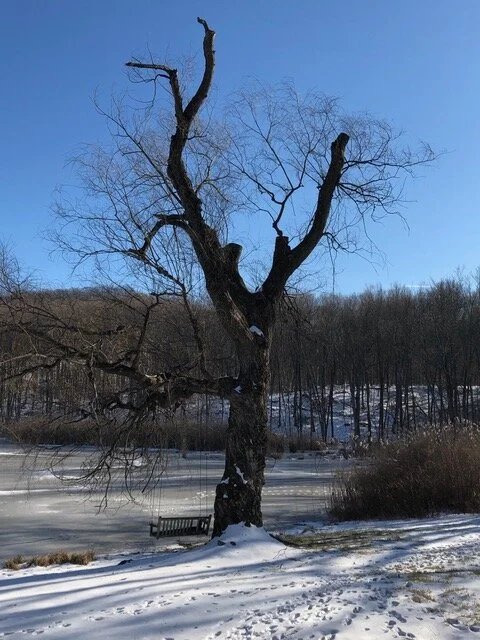
Women, Trees and Collaborative Leadership

““A willow tree in my “community”, beaten up by the strength of recent storms from our changing climate. But as tree experts tell me you can’t kill a willow. And yes, women have been “beaten up” by our patriarchal world culture, but we are rising, the feminine is rising.””
Dear Sisters,
I have been sensing for a long time that, if any group can come together across color, tribe, country, and exert the collaborative leadership and intelligence that our planetary survival is demanding, it is women.
Women are far from perfect but really, what other group includes half of humanity and has the capacity to do this?
Many people I share this thought with agree with my assessment.
In the last 30 years or so, I have delivered negotiation programs to thousands of men and women all over the world. It’s often been an “aha” -- especially to non-dominant groups -- that collaboration is one of the two main negotiation strategies. (Competition is the other). As a woman, this was a real eureka for me when I first learned this at Harvard, as I know it has been for the thousands of women who have been in my programs. Women can be plenty competitive – including myself – but, to most of us, collaboration is intuitively natural. It’s in our bones. And the fact that in the last 30 years negotiation books like Getting to Yes have celebrated “win-win” or collaborative negotiation has been a breakthrough for women. (Read my article about this here.)
I get a lot of guidance from how nature has made us and our world. For instance, the female body gives huge clues about how critical pleasure is to human existence (more on that later). And there are millions of messages coming at us from the “more-than-human” world if we are listening.
Specifically, I think we can learn a lot from trees.
Recently, I read the novel, The Overstory and listened to a podcast called The Secret Language of Trees which features an interview with Suzanne Simard, a forest ecologist.
When I first heard the podcast, I was taking a walk in the woods behind my house where I have gone thousands of times. As I was listening, I started crying seeing the community of trees around me as if for the first time. I felt some shame at just how much I haven’t noticed about them -- like, if it wasn't on my radar, it didn't exist.
Listening to Simard I learned that:
--Trees help each other.
--Trees talk to each other
--Trees use underground networks to communicate and cooperate with each other (a whole other understanding than what scientists previously thought about how nature works)
--Under a single footstep there might be hundreds of miles of fungal network
--Trees send resources back and forth (carbon, nitrogen, water etc and even defense signals) and send resources to trees that might be struggling under stress
In parallel to negotiation theory, until recently, forests in much of the world have been managed on a competition model with the assumption that each tree is an individual competing for resources.
But what Simard has found is that, while there is some competition going on, trees are all connected – kind of like a “hive-mind” and are sharing resources. The bigger and older the tree the more connected – the 'mother trees" as called by aboriginal cultures. Young seedlings regenerate from mother trees.
When a mother tree gets ready to die it deliberately passes its resources onto its “children” -- shoveling carbon towards them.
I find this so moving.
As many of us notice, our planetary world is sending out severe distress signals
Meanwhile, humans are foolishly spending huge planetary resources on killing each other, trying to dominate and extract, in what I sometimes optimistically think might be a patriarchal last gasp. As my podcast guest Terry Real so eloquently put it in our episode From the Intimate to the Global “dominion is lethal. We will move beyond patriarchy or we will die. It’s that simple.”
We have a choice in every negotiation and conflict in which we are a part – to use and model collaboration. This is NOT accommodation. This is hard and this is leadership. Women can model this in our families, to our children, at work and in the world as a force this planet so desperately needs right now.
Please stay tuned to this blog and upcoming online course material for the best ways to do this.
In an upcoming episode of The Peacebuilding Podcast, returning guest, Rabia Roberts will tell us an intriguing herstory of who women really are, how this has been obscured and misunderstood, and why women have the needed capacities and skills to bring people together. So stay tuned for that as well.
Like trees, women are so embedded in each other, like Russian nesting dolls. It amazes me that the eggs my 27 year-old-daughter carries and that will create my grandchildren (I hope:)) were made in my body, that were made in my mother’s body, that were made in my grandmother's body. I can never actually get my head around this.
Like trees, we thrive the more we are connected, collaborate and protect each other.
Author Richard Powers said that his hope in writing The Overstory is that people would give to trees “ the sanctity that we give to our own kind”.
Similarly, my hope is that women around the world realize our sacredness and unique and powerful ability to support each other in sisterhood and model the collaboration our world so desperately needs -- one negotiation at a time.
Please share this blog post with anyone you think might be interested. And please send me your thoughts in the comments section below, I love hearing them.
In sisterhood,
Susan

Bad**s Women Negotiators -- Bernadette Lukonde

““I pulled my chair (in front of this rebel commander) and went and sat in front of him and looked at him. . . he is a muslim. . . and according to Islamic norms he did not want to look directly at a woman, . . .
so, he looked away. . . but stole some glances at me. . .
and later admitted that he would agree to talk as long as I was present. . . “”
Dear Sisters,
It truly bugs me that there is still such a hidden -- or NOT SO HIDDEN -- bias that “negotiators” are male, usually white, and dress in a navy suit.
It bugs me because, while certainly men around the world are doing most of the decision and deal-making, we women are negotiating all the time.
It also bugs me because so many women don’t realize what great instincts and embedded skill we have with negotiation.
I would like to turn that around and support women globally to negotiate with the best possible skill, impact and influence
Patriarchal models have left us believing that negotiation is an adversarial power struggle where the winner takes all or, at the very least, compromise and settling for less is the name of the game.
I call this man-mode negotiation.
Donald Trump is the archetype of this style. He brags to the world that he is a first-class negotiator while, in fact, he is more of a coercive bully. That is not negotiation -- that is "win-lose" domination.
Research tells us that the most successful negotiators view the negotiation process as an opportunity for both parties to have their primary needs expressed and met. The better negotiations are "win-win", with both parties getting more of what they want in the end. And in the interdependent world in which we live, where reputation, relationships and repeat sales are critical, it is crucial that both sides be satisfied. . . again and again.
Periodically, in this blog, I plan to showcase for you some video interviews of Bad**s Women Negotiators, starting here with Bernadette Lukonde. Bernadette's job is to walk into the middle of conflict zones and convince armed rebel leaders to lay down their weapons. She does this with amazing grace, skill, humility and yes, beauty. I think she is hard to say no to.
Bernadette works with the Disarmament, Demobilization and Re-integration (DDR) unit of the UN Peacekeeping Mission in the Central African Republic (MINUSCA). Originally from Zambia she has done this work for the last 13 years in Sierra Leone, Sudan, S Sudan, Mali, and now in the Central African Republic (CAR). I met her in CAR a few months back when I was delivering a negotiation and leadership program to women peacekeepers.
I asked her how it serves her to be a woman in doing this incredibly difficult and dangerous work.
“Men don’t like to be challenged by a woman” she said.
She believes that it is more likely that rebel leaders will listen to her because she is a woman. "it softens the man’s stance -- it is easier for the rebel leader to talk and listen to her."
And, she says, it gives hope to the women in the communities she visits deep in the bush -- who along with kids are always that hardest hit by conflict -- to see a woman leading the way on the negotiation team.
““When the women see me it brings them some hope — ‘mama, you will talk to them like a mother and when you talk to them like a mother maybe they will listen and understand.’” ~ Bernadette Lukonde”
So click the the link below if you'd like to hear my full conversation with Bernadette and please share this with any woman who you think might be interested.
Honestly, if our goal is to create a more collaborative, peaceful and sustainable world, my hunch is that we women need to lead the way -- one negotiation at a time.

Healing Collective Trauma from Patriarchy
Dear Sisters,
Have you noticed how much the word trauma is in the collective discourse these days?
Do you think you carry trauma in your body, soul, brain from living in a patriarchal world culture? Do you think it affects your ability to negotiate on your own behalf; to manifest fully and powerfully what you want?
The answer to those questions for me has been a resounding YES. As I have released trauma from my body, heart, brain, I have found my ability to step into my fullness has soared. I even have grown 1.5 inches!!
Granted, it's taken me some time to get momentum with this blog. I struggle with fear around it, carving out the time, self-doubt. My intention is to get it out weekly. I am writing a book on Women and Negotiation and figure I will give you snippets of the chapters as they appear. So please stay tuned and cheer me on. I'm sure you are also struggling to get s**t done, and I cheer you on as well.
In the meantime, I just released a wonderful episode of The Peacebuilding Podcast: From Conflict to Common Ground with modern mystic Thomas Hubl. My professional end game is contributing to a world beyond armed conflict in our lifetimes. Truly our military endeavors are some of the most wasteful, destructive, painful, for all women around the globe, for the planet, for most humans. I focus on women and negotiation is because I believe our stepping into our full power is THE critical step to truly shifting the planet. The more women gain negotiation strength the more we will lead the way to more collaborative decision-making in all things intimate to the global.
My conversation with Thomas is on healing collective trauma generally, but many of my questions are about healing the collective trauma from patriarchy.
Here are some relevant lines from the episode I wrote:
"Throughout the interview, we touched on patriarchy as a collective trauma, the thousands of years patriarchal structures have been in place, their connection to war, the woman’s holocaust in Europe where millions were burned at the stake for practicing witchcraft, the challenges for women to release our codependent conditioning and step fully into our leadership and power."
"'Yes", 'Thomas agrees, "#metoo was a trauma eruption'".
"I believe (the collective trauma from patriarchy) is the core trauma of all the other traumas of domination".
You can see the entire blog post summary here or click below to listen to the episode.
Please share this with any woman who you think might be interested in content on Women, Negotiation and Power. Trying hard to build this list and your help is so valuable.

Greetings from South Sudan

Given my most recent interview with S. Sudanese, Riya Yuyada on The Peacebuilding Podcast: From Conflict to Common Ground, I thought it might interest you to see this excerpt from my post to the podcast list when I was on mission in S. Sudan in June of 2016.
Greetings from South Sudan. I am here working with UNMISS, the United Nations Peacekeeping Mission in South Sudan. It’s a privilege to be here, to be part of and experience the UN’s substantial peacekeeping efforts, and always so interesting to see the world from its many different perspectives.
I am currently in Torit, S Sudan, a more remote part of the country, living on a UN compound surrounded by soldiers and barbed wire. I feel pretty safe but kind of “in jail” as I am living in a container with no windows and can’t leave the compound without real precaution. Beyond the barbed wire, I am looking at beautiful mountains which the hiker/explorer in me would like to check out but can’t. I am awed by both the military and civilian personnel who are here for months, sometimes years at a time, eating the same diet of potatoes, rice, maize, collards, chicken, goat, working hard and living with a minimal amount of the regular pleasures that I take for granted.
I have been to S Sudan two times previously (in 2012 and 2103) as well as having worked with UNMISS in Uganda in 2014. With the perspective of time, it’s interesting to witness the newest country on earth finding it’s footing. Things are very unstable here. People are desperately poor and the government still polarized around tribal lines.
I personally see some signs of a few infrastructure improvements: I now have a real visa, whereas before I was just given a letter; my US cell carrier was able to provide me coverage, I have pretty reliable internet and now the aircraft in Juba (the capital) are not all UN, but mostly commercial carriers.
It’s been really moving to get to know people here, groundzero for the beginnings of humanity. So many have been profoundly affected by war. They have been soldiers, they have lost loved ones, they have seen the unspeakable. The country is still flooded with small and large arms and, as one man said, nothing will change until that gets cleaned up. As is my way, I am also closely tracking the situation of women, which seems really tough. Just among the people I am working with, there are so many bright women, and I see them struggle to be heard and seen as equal valuable contributors. A young, very beautiful Dinka woman I have come to know stands out. She is the first of four wives. She and her husband didn’t conceive and so he married again. When that couple didn’t conceive, he married again, etc. Apparently, it was unthinkable to consider that it might be he that has the infertility issue. The woman is shamed for not having conceived, and burdened by supporting all of the wives as she and her husband are the only two breadwinners. I am aware of both her desire to empower herself and the tremendous hurdles she faces to do so. The topic of race is also very close to the surface. While race certainly plays out differently in Africa than my country, I have heard so many deep feelings about color expressed. There is still so much misinformation. With one group I was working with, I noticed some real light-bulbs going off when I made the statement that, at a genetic level, I may be more similar to the black S Sudanese person I was talking to than to a white neighbor at home. Race is such an illusion and yet we humans have made it so important – and so destructive.
If you haven’t had a chance to listen to Riya you can do so here.

Crown The Woman

Dear Powerful Women,
You may know that I am the creator and host of The Peacebuilding Podcast: From Conflict to Common Ground. Increasingly, the episodes highlight women because, after doing this podcast for the last three years, it is crystal clear to me that women stepping into our leadership in all of our "systems" -- families, organizations, countries -- is central to building a more collaborative and peaceful world.
So, thought you would be interested in this episode with the bright and sassy Riya Yuyada, 28 year old founder of Crown the Women in South Sudan. . . This is just a soundbite. I will send you the link to the episode in about a week.
Meanwhile, if the podcast interests you, you can subscribe here.
You can also listen to our podcast here.

BATNA, Power and Patriarchy

One of the things that gives you power in a negotiation is your BATNA, or your “best alternative to a negotiated agreement”. In simple terms, it’s your walk-away position.
A beloved therapist of mine told me log ago “Susan, you can’t really negotiate unless you are willing to walk away.” She was right.
The party who has the most power in a negotiation is the party who is least dependent on the outcome of the negotiation to meet their objectives. In other words, they can walk away.
I have thought about this a lot and repeated it many times in the negotiation programs I have delivered around the world. When you are preparing for an upcoming negotiation (or difficult conversation), you need to think about what happens if it doesn’t work out. It’s key to assessing your power to influence the situation.
But here’s the thing. No human interaction ever happens in isolation.
5000 years of patriarchy influences the walk-away positions of women around the world.
Let me tell you a story, versions of which we have all heard many times.
I run an AirBnB out of my home from which I get a welcome 2nd source of income and a lot of interesting guests. One of them was an adorable, 24 yr old guy, self-described “feminist” from India who was a graduate student in New York City. I love the conversations I have with my guests, especially younger ones from far-off lands. He shared with me openly about his parents’ divorce. In the “negotiation” of his parents’ marriage (and yes, marriage is a negotiation – all the principles apply), it was OK for his Dad to be abusive to his Mom and to have affairs with other women. His Mom in contrast was the dutiful mother and wife and, while a professional herself, supported her husband as the main breadwinner. His Dad walked away from the marriage and was able, through his greater economic power and the Indian laws that privileged men, to have custody of the kids -- which was super painful to my guest.
I heard pretty much the same story from a male guide in Benin, West Africa. (I was recently working with a trade negotiation team in Ghana and came over to neighboring Benin to visit friends and learn more about the slave trade.) The guide was separated from his wife and had sole custody of their children because in his culture kids literally belong to the father. He told me, without a drop of contrition, how the Mom pleaded with him regularly to see her children and every now and then he threw her a crumb and let her catch a glimpse. In terms of patriarchal privilege, it seemed resonant with the Abomey kings he was telling me about who, 400 years earlier, had their dozens of wives buried alive with them when they died (in addition to selling fellow Africans to European slave traders).
Patriarchy is a system, it is global and, while it’s not so great for men either, it generally strengthens men’s options, or BATNA’s in the negotiations or conflicts they have with women.
Of course, this plays out in the professional world as well. A recent Harvard report in the United States on women and negotiation says that the reason women sometimes ask for less when negotiating our salaries is because we are afraid that we will be perceived as too pushy and demanding and it will backfire. And these fears are shown by the research to be warranted. Patriarchy has conditioned us to “know our place” or suffer the consequences.
Women are getting stronger throughout the world which is a welcome change for many women and men alike.
Not surprisingly, this is corresponding to a rise in authoritarian regimes around the planet. In the global gender “negotiation”, those who want to hold on to the patriarchal world order do not want to give up women’s second-class status as it’s a great source of cheaper “helpmates” in just about every nation on earth.
I say none of the to encourage you or me to feel like a victim. Being a victim takes our power away.
My message is just to be clear-eyed about our alternatives, our walk-away positions, our BATNA’s in any negotiation or conflict. We need to pop those bubbles of codependent fantasy that Prince Charming will save us, and build our capacity to walk-away from any intimate or business relationship if it isn’t working for us.
Please comment below and share this post!
If you are interested, join me for a free webinar, or online course (all coming soon) on Women, Negotiation and Power. Join the list here:

Power Over vs. Power With.

Dear Women Friends, Colleagues, Sisters,
I recently returned from Ghana where I was supporting a Ghanaian trade team in their negotiations with the economic powerhouses, in this instance, the EU. What’s always super interesting about watching simulations of negotiations is I get to see up close the microdynamics that play out on the global stage. The world is still so stuck in a win-lose, adversarial mindset, what I might call the hyper-masculine, power over v. power with, that leaves the (assumed) less powerful on the losing end. This is so limiting and short-sighted! So much value is left on the table!
What I noticed is how, I don’t think the EU reps are really negotiating at all – they are just biding time until the moment of truth, the moment when a decision must get made, and then applying their assumed greater power to get what they want. It struck me as SO STUPID as I was watching because the EU needs what Ghana is providing A LOT and using a win-lose approach just means everyone loses.
If people in the traditionally one-down position in our world, be it African trade reps or women worldwide, play by the existing rules of competition, patriarchy, zero-sum, we will probably lose – and, of course, the entire world will lose as well because we have no time left to play that game. It’s time that all of us who understand the one-down position get really good at collaboration and COLLABORATIVE LEADERSHIP.
Zero-sum rarely works anymore even tho the bully/blow-hards of the world like Donald Trump like to pontificate that it does. We women worldwide get collaboration in our DNA -- from how we raise our children to everything else. The world needs us to stop playing small, truly get what collaboration looks like, instead of accommodation and model this to the world in sisterhood.
If you’d like news on my upcoming webinars and course material on Women, Negotiation & Power and my free article on Women and Negotiation: Tips from the Field” sign up below: