Women, Trees and Collaborative Leadership

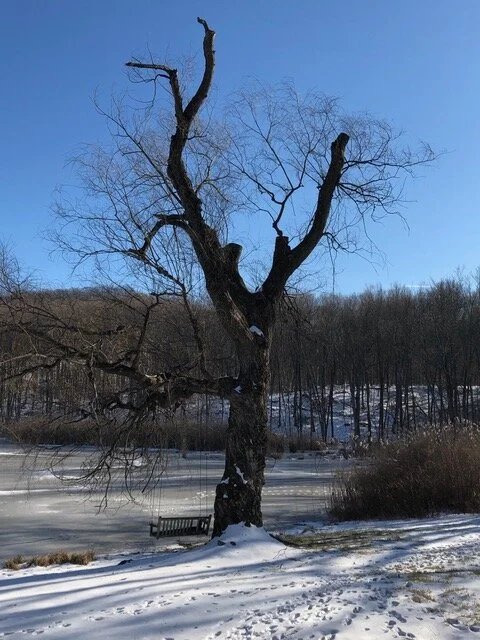
““A willow tree in my “community”, beaten up by the strength of recent storms from our changing climate. But as tree experts tell me you can’t kill a willow. And yes, women have been “beaten up” by our patriarchal world culture, but we are rising, the feminine is rising.””
Dear Sisters,
I have been sensing for a long time that, if any group can come together across color, tribe, country, and exert the collaborative leadership and intelligence that our planetary survival is demanding, it is women.
Women are far from perfect but really, what other group includes half of humanity and has the capacity to do this?
Many people I share this thought with agree with my assessment.
In the last 30 years or so, I have delivered negotiation programs to thousands of men and women all over the world. It’s often been an “aha” -- especially to non-dominant groups -- that collaboration is one of the two main negotiation strategies. (Competition is the other). As a woman, this was a real eureka for me when I first learned this at Harvard, as I know it has been for the thousands of women who have been in my programs. Women can be plenty competitive – including myself – but, to most of us, collaboration is intuitively natural. It’s in our bones. And the fact that in the last 30 years negotiation books like Getting to Yes have celebrated “win-win” or collaborative negotiation has been a breakthrough for women. (Read my article about this here.)
I get a lot of guidance from how nature has made us and our world. For instance, the female body gives huge clues about how critical pleasure is to human existence (more on that later). And there are millions of messages coming at us from the “more-than-human” world if we are listening.
Specifically, I think we can learn a lot from trees.
Recently, I read the novel, The Overstory and listened to a podcast called The Secret Language of Trees which features an interview with Suzanne Simard, a forest ecologist.
When I first heard the podcast, I was taking a walk in the woods behind my house where I have gone thousands of times. As I was listening, I started crying seeing the community of trees around me as if for the first time. I felt some shame at just how much I haven’t noticed about them -- like, if it wasn't on my radar, it didn't exist.
Listening to Simard I learned that:
--Trees help each other.
--Trees talk to each other
--Trees use underground networks to communicate and cooperate with each other (a whole other understanding than what scientists previously thought about how nature works)
--Under a single footstep there might be hundreds of miles of fungal network
--Trees send resources back and forth (carbon, nitrogen, water etc and even defense signals) and send resources to trees that might be struggling under stress
In parallel to negotiation theory, until recently, forests in much of the world have been managed on a competition model with the assumption that each tree is an individual competing for resources.
But what Simard has found is that, while there is some competition going on, trees are all connected – kind of like a “hive-mind” and are sharing resources. The bigger and older the tree the more connected – the 'mother trees" as called by aboriginal cultures. Young seedlings regenerate from mother trees.
When a mother tree gets ready to die it deliberately passes its resources onto its “children” -- shoveling carbon towards them.
I find this so moving.
As many of us notice, our planetary world is sending out severe distress signals
Meanwhile, humans are foolishly spending huge planetary resources on killing each other, trying to dominate and extract, in what I sometimes optimistically think might be a patriarchal last gasp. As my podcast guest Terry Real so eloquently put it in our episode From the Intimate to the Global “dominion is lethal. We will move beyond patriarchy or we will die. It’s that simple.”
We have a choice in every negotiation and conflict in which we are a part – to use and model collaboration. This is NOT accommodation. This is hard and this is leadership. Women can model this in our families, to our children, at work and in the world as a force this planet so desperately needs right now.
Please stay tuned to this blog and upcoming online course material for the best ways to do this.
In an upcoming episode of The Peacebuilding Podcast, returning guest, Rabia Roberts will tell us an intriguing herstory of who women really are, how this has been obscured and misunderstood, and why women have the needed capacities and skills to bring people together. So stay tuned for that as well.
Like trees, women are so embedded in each other, like Russian nesting dolls. It amazes me that the eggs my 27 year-old-daughter carries and that will create my grandchildren (I hope:)) were made in my body, that were made in my mother’s body, that were made in my grandmother's body. I can never actually get my head around this.
Like trees, we thrive the more we are connected, collaborate and protect each other.
Author Richard Powers said that his hope in writing The Overstory is that people would give to trees “ the sanctity that we give to our own kind”.
Similarly, my hope is that women around the world realize our sacredness and unique and powerful ability to support each other in sisterhood and model the collaboration our world so desperately needs -- one negotiation at a time.
Please share this blog post with anyone you think might be interested. And please send me your thoughts in the comments section below, I love hearing them.
In sisterhood,
Susan

Bad**s Women Negotiators -- Bernadette Lukonde

““I pulled my chair (in front of this rebel commander) and went and sat in front of him and looked at him. . . he is a muslim. . . and according to Islamic norms he did not want to look directly at a woman, . . .
so, he looked away. . . but stole some glances at me. . .
and later admitted that he would agree to talk as long as I was present. . . “”
Dear Sisters,
It truly bugs me that there is still such a hidden -- or NOT SO HIDDEN -- bias that “negotiators” are male, usually white, and dress in a navy suit.
It bugs me because, while certainly men around the world are doing most of the decision and deal-making, we women are negotiating all the time.
It also bugs me because so many women don’t realize what great instincts and embedded skill we have with negotiation.
I would like to turn that around and support women globally to negotiate with the best possible skill, impact and influence
Patriarchal models have left us believing that negotiation is an adversarial power struggle where the winner takes all or, at the very least, compromise and settling for less is the name of the game.
I call this man-mode negotiation.
Donald Trump is the archetype of this style. He brags to the world that he is a first-class negotiator while, in fact, he is more of a coercive bully. That is not negotiation -- that is "win-lose" domination.
Research tells us that the most successful negotiators view the negotiation process as an opportunity for both parties to have their primary needs expressed and met. The better negotiations are "win-win", with both parties getting more of what they want in the end. And in the interdependent world in which we live, where reputation, relationships and repeat sales are critical, it is crucial that both sides be satisfied. . . again and again.
Periodically, in this blog, I plan to showcase for you some video interviews of Bad**s Women Negotiators, starting here with Bernadette Lukonde. Bernadette's job is to walk into the middle of conflict zones and convince armed rebel leaders to lay down their weapons. She does this with amazing grace, skill, humility and yes, beauty. I think she is hard to say no to.
Bernadette works with the Disarmament, Demobilization and Re-integration (DDR) unit of the UN Peacekeeping Mission in the Central African Republic (MINUSCA). Originally from Zambia she has done this work for the last 13 years in Sierra Leone, Sudan, S Sudan, Mali, and now in the Central African Republic (CAR). I met her in CAR a few months back when I was delivering a negotiation and leadership program to women peacekeepers.
I asked her how it serves her to be a woman in doing this incredibly difficult and dangerous work.
“Men don’t like to be challenged by a woman” she said.
She believes that it is more likely that rebel leaders will listen to her because she is a woman. "it softens the man’s stance -- it is easier for the rebel leader to talk and listen to her."
And, she says, it gives hope to the women in the communities she visits deep in the bush -- who along with kids are always that hardest hit by conflict -- to see a woman leading the way on the negotiation team.
““When the women see me it brings them some hope — ‘mama, you will talk to them like a mother and when you talk to them like a mother maybe they will listen and understand.’” ~ Bernadette Lukonde”
So click the the link below if you'd like to hear my full conversation with Bernadette and please share this with any woman who you think might be interested.
Honestly, if our goal is to create a more collaborative, peaceful and sustainable world, my hunch is that we women need to lead the way -- one negotiation at a time.